Out of all eight planets in the Snapchat Friend Solar System, Mercury carries the most weight. It is the closest planet to the Sun in the real solar system, and Snapchat uses that exact logic inside its Friend Solar System — your Mercury is the person closest to you in terms of interaction, engagement, and digital presence on the app.
Most users who land on this page already know Mercury is a good thing. What they do not know is exactly why they received it, what specific behaviors earned it, how the algorithm decides between Mercury and Venus, and most importantly — what it takes to keep it. Because Mercury is a dynamic rank, not a permanent label, and it can disappear faster than most users realize.
This guide covers everything about the Mercury Snapchat planet: its meaning, what it looks like, how the Friend Solar System calculates who gets it, how to earn it, and how to maintain it long term.
What Is the Mercury Snapchat Planet?
The Mercury Snapchat planet is the #1 position in Snapchat’s Friend Solar System — an exclusive feature available to Snapchat Plus subscribers that visually represents your eight closest friendships as planets orbiting around you as the Sun.
When someone appears as your Mercury planet, it means they are your single most actively engaged contact on Snapchat. Conversely, when you appear as someone else’s Mercury, it means you are the person they interact with most on the entire platform — above everyone else in their friend list.
The Mercury planet on Snapchat follows the same logic as real-world astronomy. In our solar system, Mercury orbits closer to the Sun than any other planet. Snapchat mirrors this structure: the friend who interacts with you most frequently is assigned Mercury, sitting closest to you — the Sun — in your personal Friend Solar System.
This is not based on how long you have known someone, how close you are in real life, or how much you emotionally value the friendship. It is based entirely on measurable digital interaction data collected by Snapchat’s algorithm over a recent rolling time window.
Where Mercury Sits in the Snapchat Planet Order
The Snapchat Friend Solar System assigns exactly eight planets to eight friends, following the real solar system sequence from Mercury through Neptune. Mercury’s position at the very top of this ranking makes it the most recognized and sought-after planet in the entire system.
| Planet | Rank | Friendship Tier |
|---|---|---|
| Mercury | #1 | Closest best friend — highest interaction |
| Venus | #2 | Very close, second-highest interaction |
| Earth | #3 | Close, balanced friendship |
| Mars | #4 | Active, playful connection |
| Jupiter | #5 | Casual, familiar friend |
| Saturn | #6 | Fading or infrequent interaction |
| Uranus | #7 | Rare contact, distant connection |
| Neptune | #8 | Minimal interaction, weakest active bond |
There is no rank above Mercury in the Friend Solar System. It is the single highest position available, and only one friend can hold it at any given time.
What Does the Mercury Planet Look Like on Snapchat?
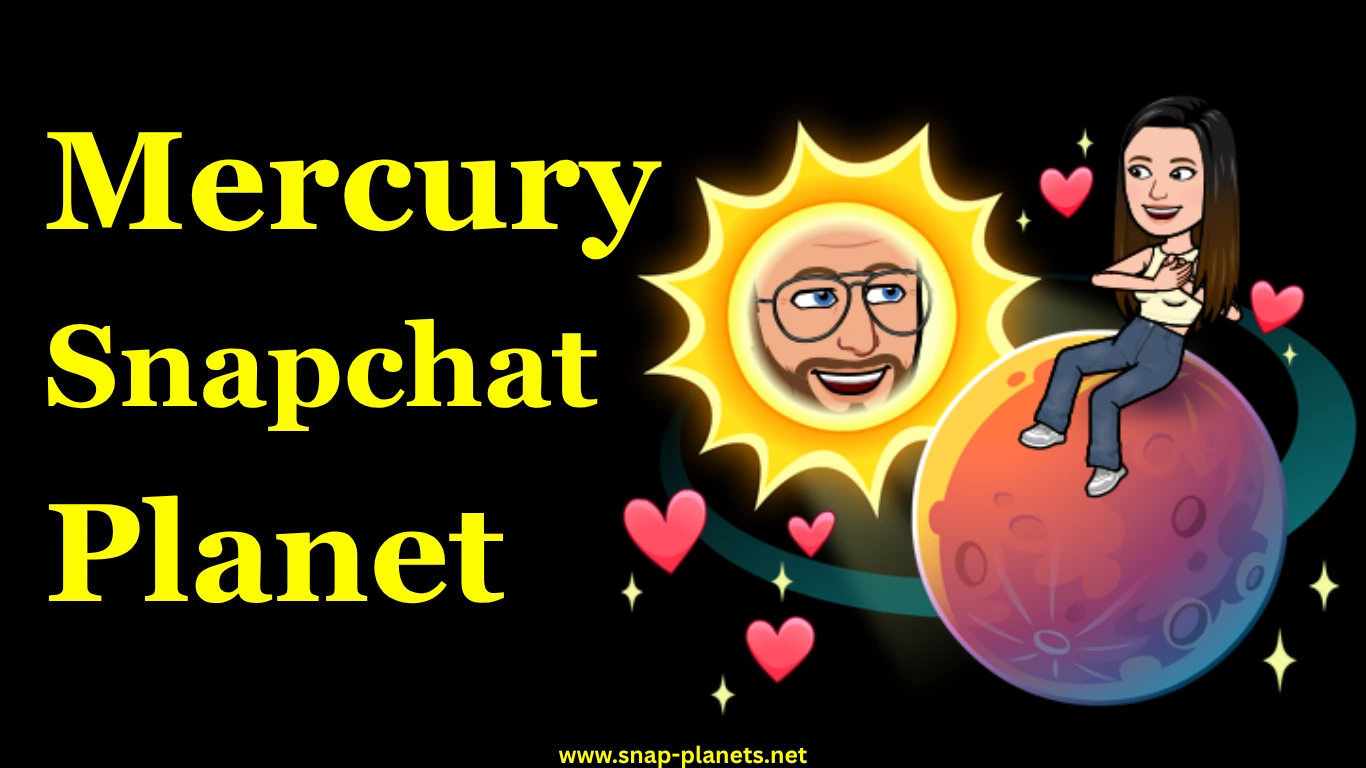
The Mercury planet icon has a specific and recognizable visual design within the Friend Solar System. Knowing what it looks like helps users identify it immediately when they see it on a profile.
Color: Bright red with warm tones — the most visually intense planet in the entire solar system display
Surrounding elements: Four small red hearts floating around the planet
Background details: Twinkling stars scattered around the edges of the display area
Glow effect: A soft radiant halo surrounding the planet surface, giving it a lit, warm appearance
Bitmoji presence: In certain display versions, a small Bitmoji character sits on or near the planet surface
The red color and red heart motifs in Mercury’s design are intentional. Red in Snapchat’s visual design language signals the highest level of emotional engagement and closeness. The four floating hearts reinforce that Mercury represents not just frequent interaction but the most valued friendship in the system. No other planet in the Friend Solar System uses red hearts — this visual detail is exclusive to Mercury.
What Does Mercury Mean on Snapchat?
Mercury on Snapchat means the friend assigned this planet is your number one best friend as determined by Snapchat’s interaction algorithm. Among every person in your friend list, this individual generates the highest composite engagement score based on all the ways you interact with each other inside the app.
What Mercury Communicates About the Friendship
When you see Mercury on someone’s profile, the Friend Solar System is telling you:
- This person sends and receives more direct snaps with you than anyone else
- Your chat frequency with this person is higher than with any other contact
- Your Snapstreak with this person — if active — is likely among your longest running
- Your combined engagement across all tracked interaction types is the strongest you have with any single person on the platform
What Mercury does not communicate is equally important. It does not mean this person is romantically interested in you. It does not measure emotional depth, trust, or real-life closeness. It does not track the content of your messages or the nature of your conversations. Mercury is a frequency metric with a visual and emotional design layer placed on top of it.
Mercury From Both Sides: A Common Source of Confusion
Planet rankings are calculated independently for each user. Your Mercury is determined by your own interaction data. Your friend’s Mercury is determined by their own interaction data. These two calculations can — and often do — produce different results.
You can be someone’s Mercury while they appear as your Venus, Earth, or even Jupiter. This is not a contradiction. It simply means that while you are their most active Snapchat contact, they interact with someone else even more frequently than they interact with you. Both rankings are simultaneously correct because they are measuring different things from different perspectives.
How Snapchat Calculates Mercury Rank
The Mercury planet is not assigned randomly or based on a single metric like snap count. Snapchat’s Friend Solar System algorithm evaluates multiple interaction signals and generates a composite friendship score for each contact. The friend with the highest score receives Mercury.
Interaction Signals and Their Weight
| Signal | Weight in Algorithm |
|---|---|
| Direct one-to-one snaps sent and received | Highest |
| Chat message frequency and initiation | High |
| Snapstreak length and daily consistency | Medium-High |
| Reply speed and consistency | Medium |
| Story reactions and replies | Medium |
| Voice and video calls within Snapchat | Medium |
| Group snap and group chat participation | Low |
Direct Snaps carry the most weight because they represent the clearest signal of intentional one-to-one engagement. Sending a snap directly to one person is a more deliberate act than participating in a group chat, and the algorithm treats it accordingly.
Chat Frequency matters not just in volume but in pattern. A friendship where both users initiate conversations independently scores higher than one where only one person always starts the interaction.
Snapstreaks provide a consistent daily signal that is difficult to replicate through any other behavior. A streak of 100+ days with mutual daily exchanges is one of the strongest indicators of Mercury-tier engagement.
Reply Speed contributes to the score at a medium level. Consistently fast replies signal that the friendship is a communication priority. Long delays or unanswered messages weaken the engagement signal over time.
Group Snaps are the lowest-weighted signal. If most of your interaction with a specific person happens through group threads rather than private one-to-one exchanges, that friendship will score significantly lower than one with the same message volume in private chat.
How to Get Mercury on Snapchat
Earning the Mercury position in a friend’s solar system requires building the highest interaction score among all their contacts. Since this is a relative ranking — you are competing against other friends in their network, not against a fixed threshold — the key is consistency and diversity of engagement signals.
Step-by-Step Approach to Earning Mercury
Step 1: Start Sending Daily Direct Snaps The foundation of Mercury rank is daily one-to-one snaps. Not group snaps, not story posts — direct private snaps sent specifically to that one friend. Even a simple, casual snap every day creates a stronger daily engagement signal than ten snaps sent in a single day once a week.
Step 2: Build and Maintain a Snapstreak Start a Snapstreak and protect it. A streak requires both users to send at least one snap to each other every 24 hours. Once a streak runs for several weeks or months, it becomes one of the strongest indicators of sustained Mercury-tier engagement in the algorithm’s calculation.
Step 3: Initiate Chat Conversations Regularly Do not only respond to their messages — start conversations yourself. Send the first message. Ask a question. React to something. The algorithm distinguishes between friendships where both users initiate and those where only one person drives the interaction. Two-way initiation scores higher.
Step 4: Reply Quickly and Consistently When you receive a snap or chat, respond without unnecessary delay. Fast, reliable replies across a sustained period signal that the friendship is a genuine priority. This is especially important in the early stages of building toward Mercury rank.
Step 5: React to Their Stories Regularly Every story reaction or reply you send generates an interaction event. Make this a regular habit rather than an occasional action. Consistent story engagement across weeks creates a cumulative contribution to your overall engagement score.
Step 6: Use Video Snaps When Possible Video snaps carry more algorithmic weight than photo snaps. Sending a short video — even just a few seconds of something casual — creates a stronger per-interaction signal. Mixing video snaps into your regular snap habit can accelerate movement toward Mercury rank.
Step 7: Engage Across Multiple Signal Types Mercury rank is most stable when it is built on multiple interaction types simultaneously — snaps, chats, story reactions, and possibly calls. A friendship that scores high on only one signal type is more vulnerable to shifting rank than one that scores moderately across all signal types.
How to Keep Mercury Rank Once You Have It
Earning Mercury is one challenge. Keeping it is a separate, ongoing one. Because the Friend Solar System recalculates rankings continuously on a rolling basis, Mercury status can shift as soon as another friendship’s interaction score overtakes yours.
Daily Habits That Sustain Mercury Rank
- Send at least one direct snap every day — do not break the daily habit
- Keep your Snapstreak active and unbroken — use reminders in the app to avoid accidental breaks
- Respond to their snaps and chats within a reasonable time consistently
- React to their stories at least a few times per week
- Continue initiating conversation — do not shift into a purely reactive communication pattern
- Use video snaps periodically to maintain a strong per-interaction signal
What Causes Mercury Rank to Drop
A New Friend Becomes More Active The most common reason for losing Mercury rank. If you begin snapping someone new very frequently, that new friendship can develop a higher score than your existing Mercury-tier friend within a single recalculation cycle. Your existing top friend does not disappear — they just drop from Mercury to Venus or lower.
Your Activity Decreases Temporarily A few days of reduced snapping during travel, exams, illness, or a busy schedule can be enough to shift rank if the recalculation cycle runs during that window. The algorithm uses recent activity data, so short-term drops in engagement have a faster effect than many users expect.
A Streak Breaks If a Snapstreak breaks, the consistent daily engagement signal it was providing disappears immediately. In cases where the streak was a significant factor in holding Mercury position, its absence can cause a rank drop within days.
Algorithm Updates Snapchat periodically adjusts how it weights different interaction signals. A change in how the system values, for example, story reactions versus direct snaps can shift planet positions across multiple friendships simultaneously, even without any change in user behavior.
Mercury on Snapchat: Best Friends Badge Explained
When you tap the planet badge on a friend’s profile to reveal Mercury, the style of the badge tells you something important about the mutual nature of the friendship ranking.
Best Friends Badge (Gold Outline)
The gold-outlined Best Friends badge appears when you are both in each other’s top eight friends. You are in their solar system and they are in yours. Tapping this badge and seeing Mercury means you hold the #1 position in their Friend Solar System.
Friends Badge (No Gold Outline)
The plain Friends badge without a gold outline appears when you are in their top eight but they are not currently in yours. Tapping this badge and seeing Mercury still means you are their #1 friend — but the interaction is not fully reciprocal at the solar system level.
No Badge Visible
If no badge appears at all on a friend’s profile, one of three things is likely: one or both users does not have an active Snapchat Plus subscription, or the Friend Solar System feature has been disabled in settings.
Mercury Snapchat Planet vs Other Planets: Full Comparison
| Planet | Rank | Snap Frequency | Streak Likely | Chat Pattern | Story Engagement |
|---|---|---|---|---|---|
| Mercury | #1 | Daily or near-daily | Yes, long-running | Regular, two-way | Consistent |
| Venus | #2 | Very frequent | Yes, active | Frequent | Regular |
| Earth | #3 | Several times a week | Sometimes | Occasional | Occasional |
| Mars | #4 | A few times a week | Sometimes | Light | Occasional |
| Jupiter | #5 | Once a week or less | Rarely | Infrequent | Rare |
| Saturn | #6 | Occasional | No | Rare | Minimal |
| Uranus | #7 | Rare | No | Very rare | Almost none |
| Neptune | #8 | Almost never | No | Barely any | None |
Privacy: Who Can See Your Mercury Planet
Privacy is built into the core design of the Friend Solar System. Mercury rank — like all planet positions — is visible only to the individual user, not to the friend being ranked or to anyone else.
- Only you can see which friend holds Mercury in your solar system
- Your Mercury-ranked friend cannot see their own position in your solar system from their account unless they check it themselves
- No followers, mutual friends, or other contacts can see any part of your Friend Solar System
- Snapchat does not send any notification when a planet position changes
This privacy design means that Mercury rank is a personal insight, not a public statement. If you want your friend to know they are your Mercury, you would need to tell them or show them directly — it is not automatic.
Disabling the Feature
The Friend Solar System can be turned off at any time. Open Snapchat, tap your Bitmoji icon, open the Snapchat Plus panel, navigate to Manage Features, and toggle Friend Solar System off. All planet badges disappear from profiles when the feature is disabled. Re-enabling it restores rankings based on current interaction data.
Is Mercury Available Without Snapchat Plus?
No. The Mercury planet and the entire Friend Solar System are exclusively available to active Snapchat Plus subscribers. The standard free version of Snapchat does not include planet badges, solar system views, or any planet-based friendship ranking.
Snapchat occasionally offers a free trial for new subscribers. During the trial period, all Snapchat Plus features including Mercury and the complete Friend Solar System are accessible. Once the trial ends, a paid subscription is required.
Conclusion
The Mercury Snapchat planet is the highest rank available in the Friend Solar System — a visual representation of your single most active friendship on the platform. It is earned through consistent daily snaps, active chat initiation, maintained Snapstreaks, and regular story engagement. It is lost when another friendship overtakes it in interaction score, when personal activity drops temporarily, or when a streak breaks.
Understanding Mercury clearly means understanding two things: what it measures and what it does not. It measures digital interaction frequency within Snapchat. It does not measure emotional depth, real-life closeness, or the overall value of a friendship. Used as a fun, approximate guide to your current Snapchat engagement patterns, Mercury is one of the most satisfying positions to hold — and with the right daily habits, one of the most maintainable.
Frequently Asked Questions About Mercury on Snapchat
What does Mercury mean on Snapchat?
Mercury on Snapchat means the person assigned this planet is your number one best friend in the Friend Solar System. They are the person you interact with most frequently on the platform, as measured by Snapchat’s interaction algorithm.
What does the Mercury planet look like on Snapchat?
The Mercury planet appears as a bright red planet with four floating red hearts, a glowing halo, and twinkling stars in the background. It is the most visually prominent planet icon in the Friend Solar System.
Can I have more than one Mercury?
No. Only one friend can hold Mercury rank at any given time. The Friend Solar System assigns exactly one friend to each of the eight planet positions.
Why did I lose Mercury rank?
The most common reasons are: another friendship became more active and overtook your score, your interaction with that friend decreased temporarily, a Snapstreak broke, or Snapchat’s algorithm recalibrated how it weights different interaction signals.
Does Mercury mean someone likes you romantically?
No. Mercury reflects interaction frequency, not romantic feeling. It can be held by a best friend, sibling, classmate, coworker, or any other type of close contact who happens to interact with you most frequently on Snapchat.
How long does it take to earn Mercury rank?
There is no fixed timeline. It depends on your relative interaction frequency compared to a friend’s other contacts. Consistent daily snapping, active chat initiation, and a maintained Snapstreak typically produce Mercury-rank results within a few weeks of sustained behavior.
Is Mercury the same on iPhone and Android?
Yes. The Mercury rank, visual design, and underlying algorithm function identically on both iOS and Android. Minor visual rendering differences may exist but the ranking logic is the same across platforms.
What happens to Mercury if I unsubscribe from Snapchat Plus?
If your Snapchat Plus subscription expires, the Friend Solar System becomes inaccessible. Planet badges disappear from profiles. Your interaction data is not deleted — if you resubscribe, rankings will reflect your current activity patterns at that time.